

Stop lying to yourself.
That is step one.
Most Australians treat their net worth calculation like a vanity project. You log into your CommBank app, stare at the “Total Assets” number, and feel a warm fuzziness in your chest. You add up your Super, the cash in your offset account, and then you do the dangerous part. You start adding the physical stuff.
The house in the suburbs. The Ranger in the driveway. That vintage watch collection you swear is going to fund your retirement.
You hop on some real estate listings. You check eBay sold listings. You pull a number out of thin air that makes you feel successful.
It is all rubbish.
I learned this the hard way back in the GFC. On paper, I was killing it. I had “assets.” I had equity. Then I needed cash fast. I tried to liquidate an investment unit I owned. The market froze. The bank didn’t care about my theoretical equity. They cared about liquidity. I ended up selling for 20% less than what the agent promised, and after fees, I barely walked away with lunch money.
If you cannot spend it tomorrow, it isn’t worth what you think it is.
Here is how you actually calculate your net worth when you hold physical assets. It won’t be pretty. But it will be real.
Asset Liquidation Value vs. Market Price
You need to apply a pain factor to every physical asset you own. I call this the Fire Sale Test. If you had to sell this item within 48 hours to save your life, what would someone actually put in your hand?
Take your car. You think it’s worth $45,000 because that is what the dealer is asking for a similar model on the lot. Wrong. The dealer has financing options, a detail shop, and a marketing budget. You have a Gumtree ad and a mobile phone. Your real number is the trade-in value, or what “Instant Offer” on Carsales will give you. That is likely $35,000.
That $10,000 gap? That is ego. Delete it from your spreadsheet.
Valuation of Property: The Hidden Costs of Real Estate
Real estate is the national sport in this country. We are obsessed. People love to say, “My house is an asset.” Sure. But it is also a liability that eats cash until the day you sell it.
When you look at the valuation of property on an online website, you are looking at a marketing algorithm. You are not looking at your take-home pay.
Here is the math I use. Take that estimated market value and immediately slash 10% off the top.
Why?
Australian real estate agent commissions might be lower than the US (around 2% to 3%), but you get hit with Vendor Paid Advertising. You pay thousands upfront to put photos on the internet. Then you have conveyancing fees. Then you have the “fix-it” requests from the buyer during the building and pest inspection. Oh, and the holding costs. Council rates don’t stop just because you put a sign in the yard.
If your place is “worth” $1,000,000, your real net worth contribution is $900,000 max. Probably less. If you owe $800,000 on the mortgage, your equity isn’t $200,000. It is $100,000. That is a 50% haircut on your perceived wealth.
Does that hurt? Good. Now you are dealing with reality.
Selling Precious Metals and Gold Coast Bullion
I love gold. I own gold. But precious metals stackers are some of the most delusional people on the planet when it comes to value.
They buy a fancy “proof” coin in a plastic slab for $3,000 because the book says it is rare. Then they try to sell it and realize the local shop only cares about the weight of the metal.
I remember walking into a Gold Coast bullion Miami dealer, and watching a bloke try to offload his “investment grade” silver. He had paid a 40% premium for cool designs from the Perth Mint. The dealer offered him a spot price. The guy stormed out.
He didn’t understand the spread.
When you value gold, silver, or jewellery, use the “bid” price, not the “ask” price. The ask price is what you pay to get it. The bid price is what a dealer pays to take it off your hands. The spread between those two numbers is friction. It is a cost.
If you own bullion, value it at spot price minus 2%. If you own jewellery, value it at melt value. I don’t care about the brand name or the craftsmanship. Unless you are willing to wait six months for a private buyer on an auction site, that craftsmanship is worth zero in a pinch.
The Real Net Worth Calculation Formula
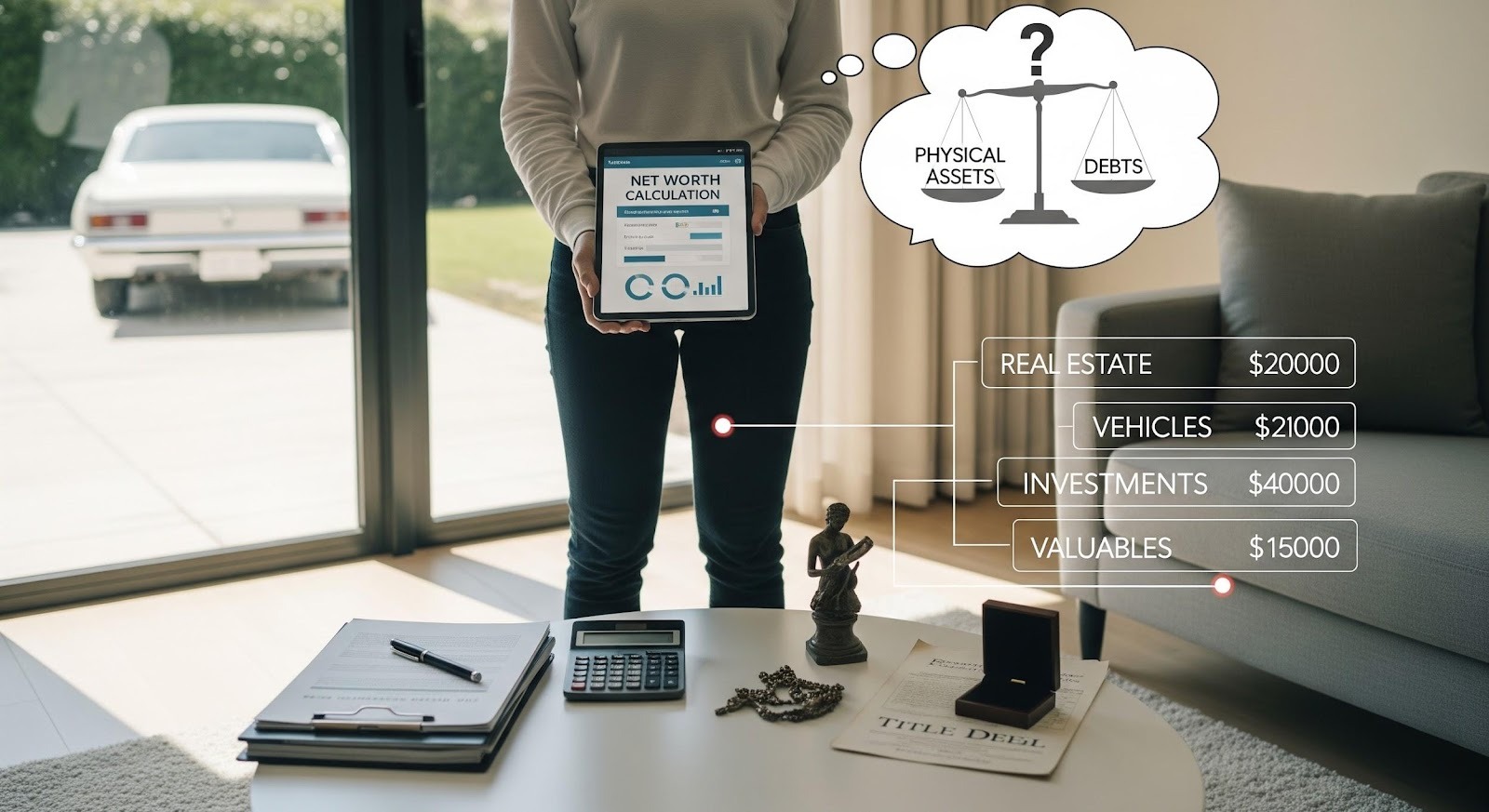
So how do you get the final number?
Stop adding up the gross value. Start calculating the “Exit Value.”
Here is the formula I use:
Asset Market Value – (Transaction Fees + Taxes + Shipping + Time Cost) = Real Net Worth
I include “Time Cost” because selling physical stuff is a job. If I have to spend 20 hours photographing, listing, and shipping items on eBay to get “market value,” I effectively bought myself a minimum wage job. I usually deduct 15% from the value of collectibles just to account for the headache.
Why Liquidity Matters More Than Paper Wealth
You might ask, “Why be so pessimistic?”
It isn’t pessimism. It is solvency.
When you measure your net worth using the Fire Sale method, you make better decisions. You stop buying things that are hard to sell. You stop hoarding junk in the garage because you think it’s an “investment.” You start prioritizing liquidity.
I would rather have $100,000 in a high-interest savings account than $150,000 tied up in antique furniture that I have to beg someone to buy.
Go look at your spreadsheet again. Be ruthless. Cut the numbers down. When you get to the bottom, that small, sad number is your actual financial foundation.
Build from there.